Re: Does Tenuto actually mean "full value"?
Posted: Sat Aug 09, 2025 8:33 am
Someone who actually plays an instrument and reads music doesn't know what "full value" means?
Believe me, this has made me scratch my head a lot.tbdana wrote: Sat Aug 09, 2025 8:33 am Someone who actually plays an instrument and reads music doesn't know what "full value" means?
harrisonreed wrote: Wed Aug 06, 2025 8:18 am It's not right. It's also in the wrong engraving font, so it will trick people into playing like squares. 2 and 3 are out completely for me.
harrisonreed wrote: Sat Aug 09, 2025 7:57 am This whole thread gives me pause especially since nearly all of the examples are not written in the correct font. That screams "arranger/writer has no idea what genre they are in or how to write for it".

Well here's another interesting side topic, when do conventions stop being so and new conventions become the norm? The use of the term "obbligato" comes to mind. I sometimes wonder how much longer circling something in the music will indicate tacit, since so many music students circle things on their parts to help remember to play it correctly.harrisonreed wrote: Sat Aug 09, 2025 7:57 am Conventions (such as > meaning "long") don't stop being conventions just because you've never played real big band charts or learned the conventions.
Often students will equate playing a whole note as "Play(one), two, three, four(off on four)" instead of "-4," if my short hand makes sense. I have worked with students before who needed to have the idea explained to them that a whole note is "Play(one), two, thee, four, off (one one)," if that makes sense.tbdana wrote: Sat Aug 09, 2025 8:33 am Someone who actually plays an instrument and reads music doesn't know what "full value" means?
Dave, come on. Seven years ago I would have agreed with you about all this. But now when I see new/poorly arranged big band charts that don't follow the historic conventions, strangely written rhythms, and are poorly engraved with bad or excessive accent markings, it is really difficult to read. It did not take very long playing in a big band for me to make that change of mind. The old way is clean and intuitive, and assumes the player is familiar with the style up front.Wilktone wrote: Sat Aug 09, 2025 8:08 pm
But seriously, font selection is important. Use something that is close to what the performers would be used to reading, when possible.
Well here's another interesting side topic, when do conventions stop being so and new conventions become the norm?harrisonreed wrote: Sat Aug 09, 2025 7:57 am Conventions (such as > meaning "long") don't stop being conventions just because you've never played real big band charts or learned the conventions.
Yeah, there's a band I sometimes play with that specializes in 1930s-1940s jazz. Much of the book are stock arrangements with very widely different notation. I don't have a bunch of stocks in my library, so I couldn't find something with the specific rhythmic example we've been discussing. But here's something close, from Song of India.Doug Elliott wrote: Sun Aug 10, 2025 11:06 am But there was lots of ambiguity and nonsensical interpretation. That's why we have conventions now, so you don't have to re-mark the parts for consistency. Well written charts should be sightreadable with virtually all the interpretation already there.

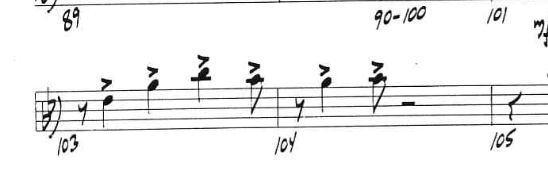

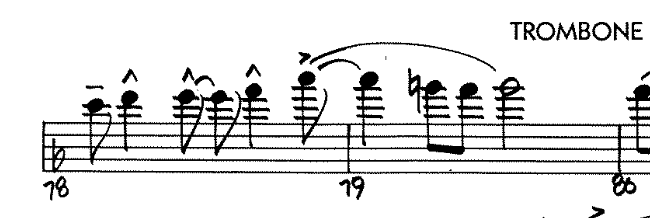
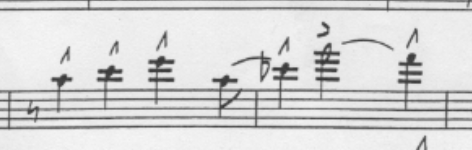
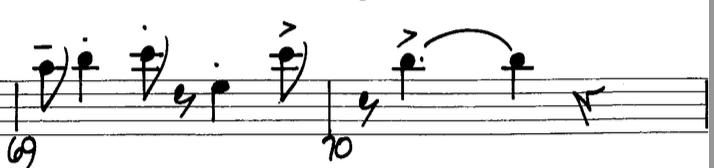
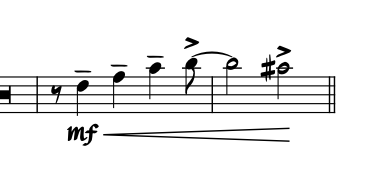

This one?harrisonreed wrote: Sun Aug 10, 2025 7:58 pm I will say that the figure with eighths with marcatos over them is NOT the same as syncopated short quarters. Those are big fat "DAHHT"s. It's notated that way on purpose.
Yes, I was focused with the rhythmic notation, but again, almost all the examples I posted have off beats that were played short by the bands that originally recorded them.Actually you've chosen a lot of examples with marcatos. Not the same thing. These examples are all clean, and not showing the same thing at all. I think you're focused on just the note start timing but missing the accents.
This one?
Yep, that's why I posed them. There are different ways that the same figure can be notated, some are better than others. With the exception of the Song of India stock arrangement, all the quarter notes (or tied 8th notes) have an articulation marked. The excerpt with the tenuto markings over them is the only one I posted intended to be played full value. As the arranger of that example I can say with absolute certainty that I wanted the off-beat quarter notes to be played connected. The groove is a bossa on that chart, by the way.Doug Elliott wrote: Sun Aug 10, 2025 8:56 pm But I think they are all different composer/arranger/copyist's versions of how to write the same thing.
Unless they aren't meant to be played long (such as the Maynard example). Different arrangers often use different ways to notate. Personally, I don't want the confusion when I put one of my own charts in front of a band for the first time, so I don't use > over quarter notes unless they are long.harrisonreed wrote: Sat Aug 09, 2025 7:57 am Conventions (such as > meaning "long") don't stop being conventions just because you've never played real big band charts or learned the conventions.
Yes, and listening to the lead player to follow their interpretation.TomInME wrote: Sun Aug 10, 2025 8:58 pm Internal consistency is more important than conventions when conventions aren't explicit and/or universally agreed-upon.
All these posts, and right there is the ultimate answer.Wilktone wrote: Mon Aug 11, 2025 7:36 am Yes, and listening to the lead player to follow their interpretation.
imagine if we had to know who the Road Commissioner was in a city when a sign was installed to discern its true meaning.Naming the composer/arranger provides important context about the notation, because they all have their quirks, and the more influential they were, the more likely those quirks became conventions.
If you don't know what country you're in, which side of the road do you drive on? Context matters. Especially when conventions aren't 100% consistent.robcat2075 wrote: Mon Aug 11, 2025 8:38 amimagine if we had to know who the Road Commissioner was in a city when a sign was installed to discern its true meaning.Naming the composer/arranger provides important context about the notation, because they all have their quirks, and the more influential they were, the more likely those quirks became conventions.
A couple observations. First, I think everything Tom said is good, except the little snark about personal biases. It's all great. But a lot of posts in this discussion don't reflect the practical aspects for someone sitting down to a part and playing it. So I just want to focus on that part for a minute. To me, it's a practical question, not a theoretical one. As a trombone player, I sit down in front of a chart and have to play it. So, what do I do when I get to those unmarked or weirdly marked quarter notes?TomInME wrote: Mon Aug 11, 2025 9:17 am As for following the lead player, what if the lead isn't playing there? What if you're the lead? How do you know what the composer was looking for?
1. If they're alive, let them know that it's not clear and ask what they meant.
2. Listen to recordings if possible, and compare them with the notation. THIS is really useful, because how you feel it should look and how it actually looks are often very different.
3. Learn the historical context.
All of those things require effort and giving up your personal biases, so I get why most people don't bother.
Composers should read that list in reverse order: historical context first, then use recordings to learn how those writers' conventions looked and sounded, then be clear about what you want (using words is OK - composers have done this for centuries).
Then you are the lead player for the moment, and it's your job to know. In practical terms, unless it's the first few bars of the chart, you've heard this rhythm played earlier by the lead player, so copy that. These interpretations get established early on in the piece and carry throughout the chart.what if the lead isn't playing there?
Then you should know how to play it. You should be able to hear it and feel it. It doesn't matter how the arranger notated it, 99% of the time you're going to know the feel. If you don't know that stuff, then look to what the lead trumpet or sax is setting down, and do that. If that didn't happen and you're just stumped, ask the damn bandleader how he wants it played. And this is big band jazz we're talking about, not some 19th century historical thing. It really doesn't matter how it was played on the recording. In jazz, people get to put their own stamp on things. If the bandleader wants it a certain way, that's the way you play it. Jazz is entirely malleable. There are conventions as general guidelines, but if the bandleader (or lead trumpet) feel it in a way different from the recording, that's how it's going to be.What if you're the lead?
In big band music, unless he's there conducting, who cares what the composer was looking for?How do you know what the composer was looking for?
TomInME wrote: Mon Aug 11, 2025 9:17 amIf you don't know what country you're in, which side of the road do you drive on? Context matters. Especially when conventions aren't 100% consistent.robcat2075 wrote: Mon Aug 11, 2025 8:38 am imagine if we had to know who the Road Commissioner was in a city when a sign was installed to discern its true meaning.
Hey! I do! When it's my music.tbdana wrote: Mon Aug 11, 2025 11:00 am In big band music, unless he's there conducting, who cares what the composer was looking for?
The players should understand the tradition and what's expected. The arranger also needs to understand the tradition and what the players need to perform the music correctly with as little ambiguity as possible.tbdana wrote: Mon Aug 11, 2025 11:00 am So, yeah, as a practical matter for musicians sitting there faced with having to figure out how to play a chart, there are conventions of how things "sound" more so than how they are "written" for big bands, so knowing those conventions solves the problem most of the time.
But if someone could convince composers/arrangers of a coherent and consistent notation convention for these things, that would obviate the need to be "in the know."
What's the biggest tell-tale sign of a non-jazz musician arranging jazz? Other than perhaps the infamous 'dotted-8th-note-16th-note' swing pattern, it's probably the use - or misuse - of articulation.
Ignoring harmony, form and the eye-sore of a font that is Inkpen 2, the most immediately obvious symbols that tell you it’s a jazz chart are the liberal use of articulation markings. Getting these wrong shows a player at first glance they'll have to figure out the phrasing on their own and that the arranger does not have their back. It would be synonymous with turning up to a session and seeing an orchestral score place the strings above the brass - no matter how well it's orchestrated, it's difficult to be taken seriously when the stylistic fundamental are so wrong.
It's a failed allegory.robcat2075 wrote: Mon Aug 11, 2025 12:00 pmTomInME wrote: Mon Aug 11, 2025 9:17 am
If you don't know what country you're in, which side of the road do you drive on? Context matters. Especially when conventions aren't 100% consistent.
(...it's an allegory.)
This really gets to the core of the discussion, because "musicians" should include the composer/arranger, and the problems result from them (or the performers) not understanding the genre. Big band is more than just a different instrumentation.tbdana wrote: Mon Aug 11, 2025 11:00 am As with any genre, musicians are expected to understand that genre's contexts and conventions.
The whole "follow the lead player" comes with a grain of salt: I have to trust them to play what's on the page, accurately, and stylistically. If that's all there then yes, absolutely follow the lead player - and it's even easy! If the lead player is guessing, then the 1st time reading a particular phrase is a crapshoot, and let's hope that the lead player plays it the same the next time around. You can't "follow the lead player" if you can't predict the lead player.Wilktone wrote: Mon Aug 11, 2025 8:31 am But as an arranger, I don't want to count on my lead players to accurately guess the articulation I want.
AndrewMeronek wrote: Mon Aug 11, 2025 3:38 pm You can't "follow the lead player" if you can't predict the lead player.

Well, that's a pretty terrible lead player, then. Either this is a group playing at a very low level (in which case you'll probably never get agreement on note duration, much less things like pitch, time, and groove), or that person has no business being on lead.AndrewMeronek wrote: Mon Aug 11, 2025 3:38 pm You can't "follow the lead player" if you can't predict the lead player.

Does Tenuto actually mean "full value"?

Sorry for the thread creep. But in our defense...AndrewMeronek wrote: Tue Aug 12, 2025 3:16 pm . . . and that brings it right back around to
Does Tenuto actually mean "full value"?
LeTromboniste wrote: Sat Aug 02, 2025 1:57 pm I meant that yes, generally that indicates full duration, but in certain contexts it means more than merely full duration. Especially in contexts where the default for an unmarked note already tends to be pretty much full duration. Then it's more about the articulation and shape of the note than the actual value
Wilktone wrote: Sat Aug 02, 2025 2:02 pm Yes, it should indicate the note is to be played full value.
Wilktone wrote: Sat Aug 02, 2025 8:36 pm Yeah, I agree that it’s strange for good players to not play tenuto full value.
None of us have come up with any examples of tenuto markings that are intended to be played full value (unless you consider portato marked with a dash and a dot, which isn't tenuto).Mamaposaune wrote: Sun Aug 03, 2025 10:52 am Back in the days when I was playing in a British-style brass band, our British-born and raised conductor said that over there, tenuto markings over the notes are meant to be played long and slightly accented.
Both, in my experience.Wilktone wrote: Fri Aug 15, 2025 9:57 am But let me ask you again, is this because the players are lazy and just not playing things full value (perhaps being unaware of their mistake) or are they misinterpreting the marking?
