
Concerning the valve, it's perfectly adjusted so I won't blame the equipment, but only myself

Here a "proof" that the G-att length is perfect for the D3, down to B2 ( sorry for the tone, I was picking the horn cold)
Thank you all for your help

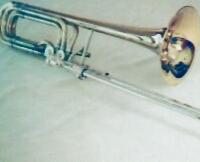
Way to go! Single-thumb-valve minor-third attachment: Eb/C, C/A, Bb/G, G/E, F/D, . . . . TYS.LIBrassCo wrote: Sun Jun 21, 2026 10:02 pm I'll snag a photo with it on the horn shortly, but for anyone with an imagination I suppose you can figure out it just looks like a 5/4:tenor trombone lol.
Little guy plays phenomenal! It's a punchy, rich tenor- es que vibe, but when I gas it right colors up into a beautiful bass sound. Crazy fun to play! I'll be bringing it to STS this week, as I know they'll be at least a couple of guys there who will get a kick out of it. That and it's just so ideal for travel. If you plan on attending and want to throw some notes through it please by all means!
You previously mentioned putting the double-trigger combination in Eb. Can you arrange the plumbing to take either an Eb or D crook? The latter would allow for a shorter stretch between Eb2 in the G-valve 5th position and D2 in 1st.
I may go a different route altogether, G/F.Sesquitone wrote: Sat Jul 04, 2026 7:04 amYou previously mentioned putting the double-trigger combination in Eb. Can you arrange the plumbing to take either an Eb or D crook? The latter would allow for a shorter stretch between Eb2 in the G-valve 5th position and D2 in 1st.
With the dependent plumbing, that won't give you a "good" C2 or (any) B1! [Actually, I misspoke before: the D double requires a larger stretch between G-valve Eb2 and double-valve D2; but the Eb double requires a larger stretch between B1 and (slide-alone) Bb1. The D double gives you a (non-pedal) Bb1 at the end of the slide.]LIBrassCo wrote: Sat Jul 04, 2026 7:12 amI may go a different route altogether, G/F.Sesquitone wrote: Sat Jul 04, 2026 7:04 am
You previously mentioned putting the double-trigger combination in Eb. Can you arrange the plumbing to take either an Eb or D crook? The latter would allow for a shorter stretch between Eb2 in the G-valve 5th position and D2 in 1st.
Yeah, I don't care about that. I'm just having some fun.Sesquitone wrote: Sat Jul 04, 2026 7:32 amWith the dependent plumbing, that won't give you a "good" C2 or (any) B1! [Actually, I misspoke before: the D double requires a larger stretch between G-valve Eb2 and double-valve D2; but the Eb double requires a larger stretch between B1 and (slide-alone) Bb1. The D double gives you a (non-pedal) Bb1 at the end of the slide.]
How about three different crooks: F (for "traditional" fun), Eb (for continuous chromatics), and D (for that non-pedal Bb1)? [Are you considering trying a matched (larger dual-bore) slide? For even more fun?]
Nope, I know what those things do, they're boring. I hate convention.Sesquitone wrote: Sat Jul 04, 2026 9:54 amHow about three different crooks: F (for "traditional" fun), Eb (for continuous chromatics), and D (for that non-pedal Bb1)? [Are you considering trying a matched (larger dual-bore) slide? For even more fun?]
Eh, I like my idea. It'll be enjoyable, that's all I care about.Sesquitone wrote: Sat Jul 04, 2026 10:52 am Starting with the single (finger-trigger) G attachment on a Bb TENOR trombone (for enhanced slide technique in the lower register), what would be "unconventional" would be to use a shorter slide—say 6 positions in Bb. With the defect made up in a longer bell. This would be a lighter and more nimble slide and give better overall balance. Ideal for beginning students (with short arms) ["hello", Mark McDunn].
If you're using the finger-trigger G attachment on a tenor/bass trombone, you would (presumably) want to fill in (continuously) those missing notes before linking to pedals. Since Bb/G is already (mostly) "unconventional", any of the continuously chromatic dependent tunings would remain so. And, of course, any of the continuously chromatic independent inline tuning would be, too. That's why I opted for Bb/G+E=D; and Bb/G+Eb=Db is another really great combination—a transposition up a P4 from the European tuning of the F contra.

The Bb/G/E tuning is, indeed, awesome. All that minor-third slide dexterity across the bass clef. And you'll have that beautiful robust C2 comfortably on the slide—perfect for transcribed cello suites.LIBrassCo wrote: Wed Jul 08, 2026 5:47 am Turns out I'm going to be able to do something awesome for the tuning, there's enough room to do it G/E, and I love the way that'll play out on the slide. That should also be enough to make everyones' heads melt a little
Hey! We agreed one one!Sesquitone wrote: Wed Jul 08, 2026 10:16 amThe Bb/G/E tuning is, indeed, awesome. All that minor-third slide dexterity across the bass clef. And you'll have that beautiful robust C2 comfortably on the slide—perfect for transcribed cello suites.LIBrassCo wrote: Wed Jul 08, 2026 5:47 am Turns out I'm going to be able to do something awesome for the tuning, there's enough room to do it G/E, and I love the way that'll play out on the slide. That should also be enough to make everyones' heads melt a little