
To provide an easily confusing example, consider a half-note. One naturally assumes that because a half-note is 2 beats long, that it ends when I count to "two". If I start counting at zero, this is true:
"zero" (note starts)
"one"
"two" (note ends)
However, the standard convention I've always seen to start counting at one means that the half-note actually ends at "three". It's the common "fencepost" problem in counting. I think that a lot of people find this to be pretty confusing.
The problem is exacerbated by the standard terminology to refer to subunits of beats: when someone says "the 'and' of one" what they mean is the 2nd eighth note in the measure, not the 4nd eighth note in the measure.
Why do we start counting beats in a measure with "one" and not "zero"?
-
AndrewMeronek
- Posts: 1567
- Joined: Fri Mar 30, 2018 6:09 pm
Why do we start counting beats in a measure with "one" and not "zero"?
“All musicians are subconsciously mathematicians.”
- Thelonious Monk
- Thelonious Monk
-
Wilktone
- Posts: 695
- Joined: Tue Mar 27, 2018 5:11 pm
Re: Why do we start counting beats in a measure with "one" and not "zero"?
For the same reason we don't count the first mile as zero.
The issue you're describing is confusing the beginning of the beat with the end of the beat. Beat one starts at the beginning of the measure and ends when beat two begins. The first mile begins as you start your journey and ends when you begin the second mile.
The issue you're describing is confusing the beginning of the beat with the end of the beat. Beat one starts at the beginning of the measure and ends when beat two begins. The first mile begins as you start your journey and ends when you begin the second mile.
-
AndrewMeronek
- Posts: 1567
- Joined: Fri Mar 30, 2018 6:09 pm
Re: Why do we start counting beats in a measure with "one" and not "zero"?
Another great example!Wilktone wrote: Sun Sep 21, 2025 8:57 am For the same reason we don't count the first mile as zero.
The issue you're describing is confusing the beginning of the beat with the end of the beat. Beat one starts at the beginning of the measure and ends when beat two begins. The first mile begins as you start your journey and ends when you begin the second mile.

We also don't say that we've gone "one" mile when we take the first step.
“All musicians are subconsciously mathematicians.”
- Thelonious Monk
- Thelonious Monk
-
claf
- Posts: 166
- Joined: Mon Oct 22, 2018 7:10 am
Re: Why do we start counting beats in a measure with "one" and not "zero"?
Because a beat is a discrete concept (even if it can be subdivised, it is usually done by powers of 2, with a notable exception with the triplets/quintuplets/...).
While a mile (or a second) is a continuous concept (we can subdivide a mile by what we want, either a quartet, a tenth, a thousandth).
Thinking about it, we can approach it differently depending on the system we use: metric is continuous while imperial could be considered discrete.
While a mile (or a second) is a continuous concept (we can subdivide a mile by what we want, either a quartet, a tenth, a thousandth).
Thinking about it, we can approach it differently depending on the system we use: metric is continuous while imperial could be considered discrete.
Gaudet TRBB
Adams TB1 Open Flow
Martin Urbie Green
Adams TB1 Open Flow
Martin Urbie Green
-
AndrewMeronek
- Posts: 1567
- Joined: Fri Mar 30, 2018 6:09 pm
Re: Why do we start counting beats in a measure with "one" and not "zero"?
I believe most people here know what the "fencepost problem" is, but just in case for those who haven't heard that term before:
https://en.wikipedia.org/wiki/Off-by-one_error
https://en.wikipedia.org/wiki/Off-by-one_error
A fencepost error (occasionally called a telegraph pole, lamp-post, or picket fence error) is a specific type of off-by-one error. An early description of this error appears in the works of Vitruvius.[1] The following problem illustrates the error:
If you build a straight fence 30 feet long with posts spaced 3 feet apart, how many posts do you need?
“All musicians are subconsciously mathematicians.”
- Thelonious Monk
- Thelonious Monk
-
BGuttman
- Posts: 7082
- Joined: Thu Mar 22, 2018 7:19 am
Re: Why do we start counting beats in a measure with "one" and not "zero"?
The issue is that we are taught to count starting at 1. The idea of starting at zero seems to have begun with the Scientific Revolution in the 17th or 18th Century, but was not adopted universally.
A half note lasts for two beats and (in 4/4 time) ends at beat 3. So the start of the note is on 1 and the end of the note should be on 3. If we considered the start of the measure to be zero, the end of the note would be on beat 2. And we would be counting measures as "0, 1, 2, 3" instead of "1, 2, 3, 4".
A half note lasts for two beats and (in 4/4 time) ends at beat 3. So the start of the note is on 1 and the end of the note should be on 3. If we considered the start of the measure to be zero, the end of the note would be on beat 2. And we would be counting measures as "0, 1, 2, 3" instead of "1, 2, 3, 4".
Bruce Guttman
Merrimack Valley Philharmonic Orchestra
"Almost Professional"
Merrimack Valley Philharmonic Orchestra
"Almost Professional"
-
AtomicClock
- Posts: 900
- Joined: Thu Oct 19, 2023 8:01 pm
Re: Why do we start counting beats in a measure with "one" and not "zero"?
I have the same problem with musical intervals. A "second" is at a distance of one note.
-
Wilktone
- Posts: 695
- Joined: Tue Mar 27, 2018 5:11 pm
Re: Why do we start counting beats in a measure with "one" and not "zero"?
I realized shortly after I made this post what a poor analogy that was, but I was already out of the house and couldn't correct myself.
I think the analogy of counting miles (or laps, or whatever) holds, but since we tend to describe distances as the *end* of the unit that it gets confusing. For example, if I'm swimming laps I might say I'm "on lap 20," meaning that I've completed 19 laps and am finishing up the 20th lap.
The other posts are better than my analogy.
I think probably a more clear way of teaching this might be to draw rectangular blocks, say four of them for 4/4 meter. Each block is a representation of the full rhythmic value for a "beat."
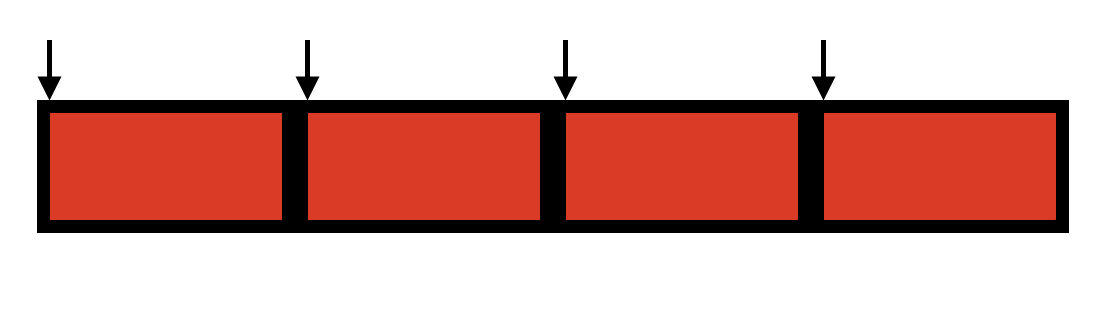
When we say "beat one" we're counting "one" at the beginning of the first block of sound. We've got four blocks, for four beats. We're "on beat one," but we haven't yet completed the full block of sound, sort of like we're on the 20th lap after completing 19 laps.
Yeah, I think that the way we traditionally describe things may lead to this confusion. So using my block analogy, you could teach that a half note is two full blocks and that rhythm should end when the second block ends, which happens to be right where the third block begins (where we count "three").AndrewMeronek wrote: Sun Sep 21, 2025 8:52 am One naturally assumes that because a half-note is 2 beats long, that it ends when I count to "two".
When we count using rhythmic solfège (such as "one and two and..." the number lands on the beginning of the block. As claf pointed out, a beat is a discrete point, not a rhythmic value.
-
LeTromboniste
- Posts: 1619
- Joined: Wed Apr 11, 2018 7:22 am
Re: Why do we start counting beats in a measure with "one" and not "zero"?
The problem arises from the fact that beats are both something we count the number of, and something we count the length of. It's impossible to avoid the fencepost problem and the potential confusion.
If we started measures on "beat 0", we would simply shift the problem in the other direction. Now you would have 4-beat measures where the last beat is called "3rd beat". In my opinion that would be more confusing than how we currently count them.
If we started measures on "beat 0", we would simply shift the problem in the other direction. Now you would have 4-beat measures where the last beat is called "3rd beat". In my opinion that would be more confusing than how we currently count them.
Maximilien Brisson
www.maximilienbrisson.com
Lecturer for baroque trombone,
Hfk Bremen/University of the Arts Bremen
www.maximilienbrisson.com
Lecturer for baroque trombone,
Hfk Bremen/University of the Arts Bremen
-
Mamaposaune
- Posts: 615
- Joined: Sat Sep 22, 2018 12:48 pm
Re: Why do we start counting beats in a measure with "one" and not "zero"?
Somewhat related, I think it was alluded to in an earlier comment, is counting dotted quarter notes and why it can be confusing to students. We tell them it gets 1 1/2 beats, then tell them to count "one and two and" making it seem as though it is longer than a half note.
Intervals are similar, one ex. being major/minor scales and how they relate. I'll tell students to go down a 3rd or up a 6th, but in almost every case they will count the 2nd note as one - i.e. CM - Am: C is one, but students counting down will call the B one.
Intervals are similar, one ex. being major/minor scales and how they relate. I'll tell students to go down a 3rd or up a 6th, but in almost every case they will count the 2nd note as one - i.e. CM - Am: C is one, but students counting down will call the B one.
-
GabrielRice
- Posts: 1575
- Joined: Fri Mar 23, 2018 7:20 am
Re: Why do we start counting beats in a measure with "one" and not "zero"?
Why does a sharp sign look so much like a natural sign, which looks so much like a flat sign?
Why don't we repeat the time signature at the beginning of every new line of manuscript like we do the key signature?
Why do we have both different clefs and transpositions in orchestral scores?
Why are there 2 (3?) different systems for reading bass clef on the French horn?
And the most important question of all: why is tuba always a principal position (with overscale) in orchestras but not bass trombone?
Why don't we repeat the time signature at the beginning of every new line of manuscript like we do the key signature?
Why do we have both different clefs and transpositions in orchestral scores?
Why are there 2 (3?) different systems for reading bass clef on the French horn?
And the most important question of all: why is tuba always a principal position (with overscale) in orchestras but not bass trombone?
Gabe Rice
Stephens Brass Instruments Artist
Faculty
Boston University School of Music
Kinhaven Music School Senior Session
Bass Trombonist
Rhode Island Philharmonic Orchestra
Vermont Symphony Orchestra
Stephens Brass Instruments Artist
Faculty
Boston University School of Music
Kinhaven Music School Senior Session
Bass Trombonist
Rhode Island Philharmonic Orchestra
Vermont Symphony Orchestra
-
AndrewMeronek
- Posts: 1567
- Joined: Fri Mar 30, 2018 6:09 pm
Re: Why do we start counting beats in a measure with "one" and not "zero"?
I don't think that it's not a poor analogy, I think it's interesting. You describe both the "first mile" and counting miles after completion of said miles. Maybe there is some similar language we can clarify when measuring beats, whether we mean "the end of beat 1" or "the start of beat 1" or "in-between the start and end of beat 1" ?Wilktone wrote: Sun Sep 21, 2025 10:46 am I realized shortly after I made this post what a poor analogy that was, but I was already out of the house and couldn't correct myself.
“All musicians are subconsciously mathematicians.”
- Thelonious Monk
- Thelonious Monk
-
AndrewMeronek
- Posts: 1567
- Joined: Fri Mar 30, 2018 6:09 pm
Re: Why do we start counting beats in a measure with "one" and not "zero"?
For a bit more context:
What got me thinking about this is watching this video about reading rhythms. I was curious to see how she would approach talking about it, and I noticed that she marked the beats with her vertical green lines (and referred to the beats while talking) specifically at the end of the beats, not at the beginning. I think that at least part of what this means is that we can't assume that it's universal (in English) to assume that when someone says "beat 1" that they mean either the start or the end, without clarification.
FYI Sarah Jeffrey makes excellent music education videos.
What got me thinking about this is watching this video about reading rhythms. I was curious to see how she would approach talking about it, and I noticed that she marked the beats with her vertical green lines (and referred to the beats while talking) specifically at the end of the beats, not at the beginning. I think that at least part of what this means is that we can't assume that it's universal (in English) to assume that when someone says "beat 1" that they mean either the start or the end, without clarification.
FYI Sarah Jeffrey makes excellent music education videos.
“All musicians are subconsciously mathematicians.”
- Thelonious Monk
- Thelonious Monk
-
AndrewMeronek
- Posts: 1567
- Joined: Fri Mar 30, 2018 6:09 pm
Re: Why do we start counting beats in a measure with "one" and not "zero"?
Now you're getting to the truly important questions!GabrielRice wrote: Sun Sep 21, 2025 12:04 pm And the most important question of all: why is tuba always a principal position (with overscale) in orchestras but not bass trombone?
“All musicians are subconsciously mathematicians.”
- Thelonious Monk
- Thelonious Monk
-
robcat2075

- Posts: 1859
- Joined: Mon Sep 03, 2018 2:58 pm
Re: Why do we start counting beats in a measure with "one" and not "zero"?
It's the difference between cardinal numbers (1, 2, 3, 4...) and whole numbers (0, 1, 2, 3...) and our practical sense of when to use one or the zother.
We call the initial beat "beat one" because we regard it to be something rather than nothing, the first of a set rather than a zeroed-out scale about to weigh something.
I'll note that in my year of teaching public school band I encountered zero students who, even in their most manufactured moments of cluelessness, asked why the first beat wasn't "beat zero".
Imagine telling fifth graders, "Listen everyone, this piece is in 4/4 time! 0, 1, 2, 3, 0, 1, 2, 3..."
We call the initial beat "beat one" because we regard it to be something rather than nothing, the first of a set rather than a zeroed-out scale about to weigh something.
I'll note that in my year of teaching public school band I encountered zero students who, even in their most manufactured moments of cluelessness, asked why the first beat wasn't "beat zero".
Imagine telling fifth graders, "Listen everyone, this piece is in 4/4 time! 0, 1, 2, 3, 0, 1, 2, 3..."
Last edited by robcat2075 on Sun Sep 21, 2025 3:31 pm, edited 1 time in total.
-
brassmedic
- Posts: 1399
- Joined: Fri Dec 14, 2018 12:07 pm
Re: Why do we start counting beats in a measure with "one" and not "zero"?
I agree with robcat. Zero means non-existent. If I have zero apples, I don't have any apples. That's why we count things starting with one. Talking about a 0th beat is nonsensical. A quarter note that starts on beat one ends on beat two. It ENDS there; it does not occupy any part of beat 2. I've never been confused by that. It is perfectly logical to me. I don't see it as being a fencepost problem. A fencepost is a physical structure that has a physical width and occupies physical space. There is no analogous structure for beats. I thought the mile analogy was good. The second mile starts exactly where the first mile ends. The first mile does not occupy any part of the second mile.
If a teacher is really bothered by, say, a half note and counting to 3, they can always say, "one and two and off". I've definitely heard that before.
If a teacher is really bothered by, say, a half note and counting to 3, they can always say, "one and two and off". I've definitely heard that before.
Last edited by brassmedic on Sun Sep 21, 2025 4:42 pm, edited 1 time in total.
Brad Close Brass Instruments - brassmedic.com
-
timothy42b
- Posts: 1799
- Joined: Tue Mar 27, 2018 5:51 am
Re: Why do we start counting beats in a measure with "one" and not "zero"?
An exercise I do for shoulder impingement is to hang from a chinup bar for a set number of seconds.
To count seconds, I turn on metronome set to 60. When my position is correct I start my count at "zero."
If you're hanging for 30 seconds the difference between starting at 1 versus 0 is meaningless, but if you're doing 5 seconds of isometrics it might be huge. Either way though, zero is more precise.
I didn't invent the "start at zero" idea, it came from some fitness site and was common practice among some set of athletes. .
To count seconds, I turn on metronome set to 60. When my position is correct I start my count at "zero."
If you're hanging for 30 seconds the difference between starting at 1 versus 0 is meaningless, but if you're doing 5 seconds of isometrics it might be huge. Either way though, zero is more precise.
I didn't invent the "start at zero" idea, it came from some fitness site and was common practice among some set of athletes. .
-
Sesquitone
- Posts: 274
- Joined: Mon Apr 25, 2022 12:26 pm
Re: Why do we start counting beats in a measure with "one" and not "zero"?
It depends on whether you're measuring elapsed time (start at zero) or entities lined up in space or time (start at one). Nurses are trained to take a pulse for 15 seconds and then multiply by 4 to get the "beats per minute" figure. Unfortunately, they typically start counting (incorrectly) at "one" when they start their stop-watch, so their pulse measurement can be four beats too high if there's a pulse detected right at the 15-second point.timothy42b wrote: Sun Sep 21, 2025 4:22 pm An exercise I do for shoulder impingement is to hang from a chinup bar for a set number of seconds.
To count seconds, I turn on metronome set to 60. When my position is correct I start my count at "zero."
If you're hanging for 30 seconds the difference between starting at 1 versus 0 is meaningless, but if you're doing 5 seconds of isometrics it might be huge. Either way though, zero is more precise.
I didn't invent the "start at zero" idea, it came from some fitness site and was common practice among some set of athletes. .
If I clap my hands 20 times in 4 seconds, the clap frequency is the number of claps divided by the elapsed time: 20/(4 s) = 5/s = 5 Hz. Do I start counting claps at "one" and not count the last clap that occurs right at the 4-second point; or start counting at "zero" and include the last clap?
There is a well-known "mathematical" joke. In the old days (when you could check a lot of bags on a flight), a professional mathematician and his wife arrive at check-in, with the bags neatly lined up in a row before they're to be loaded onto the scale. The mathematician exclaims to his wife, "Oh no! You said we had four bags. We must have left one in the car". His wife responds, "No, dear, there are four bags there." The mathematician is insistent, "No, look! Count them: zero, one, two, three!"
-
claf
- Posts: 166
- Joined: Mon Oct 22, 2018 7:10 am
Re: Why do we start counting beats in a measure with "one" and not "zero"?
It does not start at zero.
It's at zero before starting.
After it has started, it's not zero, it's 0 point something, or some milliseconds, which is a lot more than 0.
I hope nobody counts millibeats.
It's at zero before starting.
After it has started, it's not zero, it's 0 point something, or some milliseconds, which is a lot more than 0.
I hope nobody counts millibeats.
Gaudet TRBB
Adams TB1 Open Flow
Martin Urbie Green
Adams TB1 Open Flow
Martin Urbie Green
-
LeTromboniste
- Posts: 1619
- Joined: Wed Apr 11, 2018 7:22 am
Re: Why do we start counting beats in a measure with "one" and not "zero"?
I know Gabe's post was all tongue-in-cheek, but,
The natural sign has corners, and is originally a "square" or hard b indicating that it's to be sung as "mi", a half-step below C (sung "fa"), while the flat sign is a "round" or soft b indicating it's sung "fa", a half-step above A (sung "mi", or eventually "la").

The modern German nomenclature has kept some remnants of these notions. Germans call B natural "H" (with B meaning Bb) because the natural sign ressembles the lowercase h of their Fraktur script (which they still used in everyday printed writing well into the 20th century)

Also, as an extension to the original idea of hexachords containing Bb being called soft or "mollem", and B natural hard or "durum", they call major tonalities "dur" and minor tonalities "moll".
The natural sign and the flat sign are both originally different shapes of the letter b, so it's not surprising that these two symbols look similar. On the other hand, the earlier versions of the sharp sign were much less similar, with the parallel lines much closer together, and the whole thing rotated 45 degrees (but today that would create confusion with the double sharp symbol, well as require different half-sharp and sharp-and-a-half symbols).GabrielRice wrote: Sun Sep 21, 2025 12:04 pm Why does a sharp sign look so much like a natural sign, which looks so much like a flat sign?
The natural sign has corners, and is originally a "square" or hard b indicating that it's to be sung as "mi", a half-step below C (sung "fa"), while the flat sign is a "round" or soft b indicating it's sung "fa", a half-step above A (sung "mi", or eventually "la").
The modern German nomenclature has kept some remnants of these notions. Germans call B natural "H" (with B meaning Bb) because the natural sign ressembles the lowercase h of their Fraktur script (which they still used in everyday printed writing well into the 20th century)
Also, as an extension to the original idea of hexachords containing Bb being called soft or "mollem", and B natural hard or "durum", they call major tonalities "dur" and minor tonalities "moll".
Last edited by LeTromboniste on Mon Sep 22, 2025 7:03 am, edited 1 time in total.
Maximilien Brisson
www.maximilienbrisson.com
Lecturer for baroque trombone,
Hfk Bremen/University of the Arts Bremen
www.maximilienbrisson.com
Lecturer for baroque trombone,
Hfk Bremen/University of the Arts Bremen
-
timothy42b
- Posts: 1799
- Joined: Tue Mar 27, 2018 5:51 am
Re: Why do we start counting beats in a measure with "one" and not "zero"?
Ah ha!Sesquitone wrote: Sun Sep 21, 2025 9:14 pm
It depends on whether you're measuring elapsed time (start at zero) or entities lined up in space or time (start at one). Nurses are trained to take a pulse for 15 seconds and then multiply by 4 to get the "beats per minute" figure. Unfortunately, they typically start counting (incorrectly) at "one" when they start their stop-watch, so their pulse measurement can be four beats too high if there's a pulse detected right at the 15-second point.
Long ago I worked in a hospital. Among messier tasks, I took pulse and blood pressures on incoming mental patients.
I was taught to start counting at zero.
I had forgotten that over the years. My job at a state mental hospital was 1982 to 1990.
-
harrisonreed
- Posts: 6329
- Joined: Fri Aug 17, 2018 12:18 pm

Re: Why do we start counting beats in a measure with "one" and not "zero"?
You all are way overthinking this.
In music we count the start of the beat, NOT the completion of the beat. There is no reason to stop doing this or question why we do this. You're counting the downbeats. I know foot tapping is taboo ... but if you try it ... the first tap happens right at the very beginning of the measure, it starts the measure, and that beat is over once the second foot tap happens. Your foot going up and then back down constitutes the upbeat into beat two.
The downbeats, which are what is being counted, happen precisely at the start of the measure, are evenly spaced throughout the measure according to the time signature, and by themselves have zero temporal length.
Now, if you want to get into what "three measures after 'A'" means ... I'll bring the popcorn. The A is on the barline ... is bar "A" one after "A"? Is "A" the barline?
Who knows.
In music we count the start of the beat, NOT the completion of the beat. There is no reason to stop doing this or question why we do this. You're counting the downbeats. I know foot tapping is taboo ... but if you try it ... the first tap happens right at the very beginning of the measure, it starts the measure, and that beat is over once the second foot tap happens. Your foot going up and then back down constitutes the upbeat into beat two.
The downbeats, which are what is being counted, happen precisely at the start of the measure, are evenly spaced throughout the measure according to the time signature, and by themselves have zero temporal length.
Now, if you want to get into what "three measures after 'A'" means ... I'll bring the popcorn. The A is on the barline ... is bar "A" one after "A"? Is "A" the barline?
Who knows.
- Harrison Reed
Harry's Custom Mouthpieces
Harry's Custom Mouthpieces
-
LeTromboniste
- Posts: 1619
- Joined: Wed Apr 11, 2018 7:22 am
Re: Why do we start counting beats in a measure with "one" and not "zero"?
This legit is something good conducting teachers teach their students in the first week of conducting seminar. As a conductor you may say "n measures before X" when counting backwards, but when counting forwards the word "after" is forbidden and you must always say "nth measure of X"harrisonreed wrote: Mon Sep 22, 2025 7:14 am Now, if you want to get into what "three measures after 'A'" means ... I'll bring the popcorn. The A is on the barline ... is bar "A" one after "A"? Is "A" the barline?
Who knows.
Maximilien Brisson
www.maximilienbrisson.com
Lecturer for baroque trombone,
Hfk Bremen/University of the Arts Bremen
www.maximilienbrisson.com
Lecturer for baroque trombone,
Hfk Bremen/University of the Arts Bremen
-
JTeagarden
- Posts: 803
- Joined: Mon Feb 24, 2025 8:37 am
Re: Why do we start counting beats in a measure with "one" and not "zero"?
Wow, just when it seemed a topic couldn't be more tedious.
-
Wilktone
- Posts: 695
- Joined: Tue Mar 27, 2018 5:11 pm
Re: Why do we start counting beats in a measure with "one" and not "zero"?
I've found that the best things for my musicianship are often the things that are tedious. They're not enjoyable, but the results usually are.JTeagarden wrote: Mon Sep 22, 2025 9:04 am Wow, just when it seemed a topic couldn't be more tedious.
-
JTeagarden
- Posts: 803
- Joined: Mon Feb 24, 2025 8:37 am
Re: Why do we start counting beats in a measure with "one" and not "zero"?
This is generally true, not sure about discussing the convention of starting to count with one, though.Wilktone wrote: Mon Sep 22, 2025 9:08 amI've found that the best things for my musicianship are often the things that are tedious. They're not enjoyable, but the results usually are.JTeagarden wrote: Mon Sep 22, 2025 9:04 am Wow, just when it seemed a topic couldn't be more tedious.
-
brassmedic
- Posts: 1399
- Joined: Fri Dec 14, 2018 12:07 pm
Re: Why do we start counting beats in a measure with "one" and not "zero"?
I don't get this. You would be counting heartbeats, wouldn't you? A heartbeat being an event, you are counting how many events take place in a given time period, so wouldn't you start counting at one? There is no 0th heartbeat. As for the elapsed time, you would be using a stopwatch, which DOES start at zero, wouldn't you? So under what scenario would you want to begin counting at zero? The stopwatch does that automatically.timothy42b wrote: Mon Sep 22, 2025 6:11 amAh ha!Sesquitone wrote: Sun Sep 21, 2025 9:14 pm
It depends on whether you're measuring elapsed time (start at zero) or entities lined up in space or time (start at one). Nurses are trained to take a pulse for 15 seconds and then multiply by 4 to get the "beats per minute" figure. Unfortunately, they typically start counting (incorrectly) at "one" when they start their stop-watch, so their pulse measurement can be four beats too high if there's a pulse detected right at the 15-second point.
Long ago I worked in a hospital. Among messier tasks, I took pulse and blood pressures on incoming mental patients.
I was taught to start counting at zero.
I had forgotten that over the years. My job at a state mental hospital was 1982 to 1990.
Brad Close Brass Instruments - brassmedic.com
-
Sesquitone
- Posts: 274
- Joined: Mon Apr 25, 2022 12:26 pm
Re: Why do we start counting beats in a measure with "one" and not "zero"?
Perhaps this will liven things up a bit. I have mentioned "Libet time" before. Basically, this means that the "real world" is happening about 500 ms before we (humans) are aware of it—including things happening inside our own body, in particular, decisions we make and actions based on those decisions. So you're playing quarter notes in 4/4 at a tempo of quarter-note = 120. You're thinking: "one, two, three, four, . . ." as you play. But, in the "real world", you're actually playing notes required on "two, three, four, one, . . ."—i.e half-a-second ahead of what you're aware of what you're actually doing. If you're improvising, and decide to make a little four-note run in sixteenth notes, you've actually played all of those notes before you are aware of deciding which notes to play!JTeagarden wrote: Mon Sep 22, 2025 9:04 am Wow, just when it seemed a topic couldn't be more tedious.
-
Sesquitone
- Posts: 274
- Joined: Mon Apr 25, 2022 12:26 pm
Re: Why do we start counting beats in a measure with "one" and not "zero"?
Okay, so wait until you're feeling the pulse "beats". Assuming the pulse is fairly uniform, you can anticipate subsequent beats. Click on the stop-watch synchronised with any beat. Click it off synchronised with the very next beat. You have measured the time interval between two consecutive beats—i.e. ONE pulse period. Did you count "one, two" or "zero, one"? Frequency is the reciprocal of period, so the pulse frequency is the number 1 (not 2) divided by the stop-watch measurement (presumably in seconds), giving the frequency in hertz. Multiply by 60 to give the frequency in (so-called) Beats Per Minute (BPM). If you count beats over a fixed time interval (e.g. 15 s) and you count the beat nearest in time to the end of that 15 s interval, you want to know the number of periods for that time interval—the number of "spaces between fence posts", not the total number of fence posts (which is one more). That's why you (should) start counting pulse beats at zero, not one. Then divide by the time interval (to give frequency in hertz) then multiply by 60. [Equivalent to multiplying the beats you counted (starting at zero) by 4.]brassmedic wrote: Mon Sep 22, 2025 1:48 pm I don't get this. You would be counting heartbeats, wouldn't you? A heartbeat being an event, you are counting how many events take place in a given time period, so wouldn't you start counting at one? There is no 0th heartbeat. As for the elapsed time, you would be using a stopwatch, which DOES start at zero, wouldn't you? So under what scenario would you want to begin counting at zero? The stopwatch does that automatically.
-
JTeagarden
- Posts: 803
- Joined: Mon Feb 24, 2025 8:37 am
Re: Why do we start counting beats in a measure with "one" and not "zero"?
Now I've gone from bored to thoroughly confused, I get this a lot 
The idea that we perceive the world only after it takes place is an interesting one, ideally we all have about the same lag time...
The idea that we perceive the world only after it takes place is an interesting one, ideally we all have about the same lag time...
Last edited by JTeagarden on Mon Sep 22, 2025 2:54 pm, edited 1 time in total.
-
harrisonreed
- Posts: 6329
- Joined: Fri Aug 17, 2018 12:18 pm
Re: Why do we start counting beats in a measure with "one" and not "zero"?
Sesquitone wrote: Mon Sep 22, 2025 1:58 pmPerhaps this will liven things up a bit. I have mentioned "Libet time" before. Basically, this means that the "real world" is happening about 500 ms before we (humans) are aware of it—including things happening inside our own body, in particular, decisions we make and actions based on those decisions. So you're playing quarter notes in 4/4 at a tempo of quarter-note = 120. You're thinking: "one, two, three, four, . . ." as you play. But, in the "real world", you're actually playing notes required on "two, three, four, one, . . ."—i.e half-a-second ahead of what you're aware of what you're actually doing. If you're improvising, and decide to make a little four-note run in sixteenth notes, you've actually played all of those notes before you are aware of deciding which notes to play!JTeagarden wrote: Mon Sep 22, 2025 9:04 am Wow, just when it seemed a topic couldn't be more tedious.
- Harrison Reed
Harry's Custom Mouthpieces
Harry's Custom Mouthpieces
-
AtomicClock
- Posts: 900
- Joined: Thu Oct 19, 2023 8:01 pm
Re: Why do we start counting beats in a measure with "one" and not "zero"?
There is another parallel in motoring. The "three second rule" is one of the methods of finding a safe following distance. But if you don't start counting at zero, you're only measuring two seconds.
Of course, that only works when your road network ISN'T congested and overloaded. Sigh.
Of course, that only works when your road network ISN'T congested and overloaded. Sigh.
-
BGuttman
- Posts: 7082
- Joined: Thu Mar 22, 2018 7:19 am
Re: Why do we start counting beats in a measure with "one" and not "zero"?
First: when measuring a person's pulse, you are counting heartbeats in a particular time period. Starting the stopwatch on a pulse is as good a start time as any, and that is pulse 1. You will measure for a fixed time, not a number of pulses. Multiplying the result by whatever it takes to make one minute will be accurate enough except in the (rare) case that another pulse occurs exactly at your stop time. In this latter case your result will be off by the factor you used to make the minute. For example, you measure pulse for 15 seconds (¼ minute) and you get 21 pulses, but no pulse occurred on the 15th second. You get a pulse of 84. If you get a pulse of 21 but the first and last pulses occur exactly on the start and stop of your timing, your 84 should actually be 80. This is a pretty small error in pulse value, so counting starting on 1 is perfectly valid. Also, worrying about whether the last pulse occurred exactly on your stop point is kinda immaterial. Note that the error gets larger if your measurement is based on 5 seconds, where an error of 1 translates to 12 beats per minute, which is a much bigger factor.
Remember, we are counting beats, not marking their location. Beat one starts at location zero; beat two starts at location 1, etc.
Remember, we are counting beats, not marking their location. Beat one starts at location zero; beat two starts at location 1, etc.
Bruce Guttman
Merrimack Valley Philharmonic Orchestra
"Almost Professional"
Merrimack Valley Philharmonic Orchestra
"Almost Professional"
-
brassmedic
- Posts: 1399
- Joined: Fri Dec 14, 2018 12:07 pm
Re: Why do we start counting beats in a measure with "one" and not "zero"?
You sure made that unnecessarily complicated. If you don't try to synch a heartbeat with starting the stopwatch, then you don't have to count from zero. Just start the stopwatch and count the heartbeats as they come.Sesquitone wrote: Mon Sep 22, 2025 2:29 pmOkay, so wait until you're feeling the pulse "beats". Assuming the pulse is fairly uniform, you can anticipate subsequent beats. Click on the stop-watch synchronised with any beat. Click it off synchronised with the very next beat. You have measured the time interval between two consecutive beats—i.e. ONE pulse period. Did you count "one, two" or "zero, one"? Frequency is the reciprocal of period, so the pulse frequency is the number 1 (not 2) divided by the stop-watch measurement (presumably in seconds), giving the frequency in hertz. Multiply by 60 to give the frequency in (so-called) Beats Per Minute (BPM). If you count beats over a fixed time interval (e.g. 15 s) and you count the beat nearest in time to the end of that 15 s interval, you want to know the number of periods for that time interval—the number of "spaces between fence posts", not the total number of fence posts (which is one more). That's why you (should) start counting pulse beats at zero, not one. Then divide by the time interval (to give frequency in hertz) then multiply by 60. [Equivalent to multiplying the beats you counted (starting at zero) by 4.]brassmedic wrote: Mon Sep 22, 2025 1:48 pm I don't get this. You would be counting heartbeats, wouldn't you? A heartbeat being an event, you are counting how many events take place in a given time period, so wouldn't you start counting at one? There is no 0th heartbeat. As for the elapsed time, you would be using a stopwatch, which DOES start at zero, wouldn't you? So under what scenario would you want to begin counting at zero? The stopwatch does that automatically.
Brad Close Brass Instruments - brassmedic.com
-
brassmedic
- Posts: 1399
- Joined: Fri Dec 14, 2018 12:07 pm
Re: Why do we start counting beats in a measure with "one" and not "zero"?
I think you're supposed to say "one one thousand, two one thousand, three one thousand" so the duration of each second is accounted for.AtomicClock wrote: Mon Sep 22, 2025 3:41 pm There is another parallel in motoring. The "three second rule" is one of the methods of finding a safe following distance. But if you don't start counting at zero, you're only measuring two seconds.
Of course, that only works when your road network ISN'T congested and overloaded. Sigh.
Brad Close Brass Instruments - brassmedic.com
-
brassmedic
- Posts: 1399
- Joined: Fri Dec 14, 2018 12:07 pm
Re: Why do we start counting beats in a measure with "one" and not "zero"?
A isn't a bar. A is a rehearsal letter that falls on the barline. "One after A" is the bar immediately after the letter A. Of course you would never say that because you would just say "Start at A". Better yet, as pointed out, you should say, "The fourth bar of A", or whatever the case may be. It's like if you said, "My house is on the first block after the stop sign. The stop sign isn't a block; it's a point of reference.harrisonreed wrote: Mon Sep 22, 2025 7:14 am
Now, if you want to get into what "three measures after 'A'" means ... I'll bring the popcorn. The A is on the barline ... is bar "A" one after "A"? Is "A" the barline?
Who knows.
Why do whole rests and half rests look exactly the same and are just in slightly different locations?
Brad Close Brass Instruments - brassmedic.com
-
AtomicClock
- Posts: 900
- Joined: Thu Oct 19, 2023 8:01 pm
Re: Why do we start counting beats in a measure with "one" and not "zero"?
Except that "the fourth bar of A" implies A is not a singular location, but a range of measures starting at the symbol A and going up to (presumably) the B. So depending on how the instruction is phrased, you have to change your whole context before finding the spot.
In some Grainger band music, the rehearsal marks (numbers, I think) are centered over the measure, not over a barline. Ugh!
In some Grainger band music, the rehearsal marks (numbers, I think) are centered over the measure, not over a barline. Ugh!
-
brassmedic
- Posts: 1399
- Joined: Fri Dec 14, 2018 12:07 pm
Re: Why do we start counting beats in a measure with "one" and not "zero"?
But those are measure numbers, correct? Measure numbers DO indicate measures. So if 15 is centered over the bar, you could either say, "Start one bar after 15", or "Start at measure 16". In fact, measure numbers should never be placed directly over or under a barline, because that would be confusing. And BTW, when measure numbers are used, the first measure is always one, not zero.AtomicClock wrote: Mon Sep 22, 2025 10:18 pm
In some Grainger band music, the rehearsal marks (numbers, I think) are centered over the measure, not over a barline. Ugh!
Last edited by brassmedic on Tue Sep 23, 2025 10:02 am, edited 1 time in total.
Brad Close Brass Instruments - brassmedic.com
-
AtomicClock
- Posts: 900
- Joined: Thu Oct 19, 2023 8:01 pm
Re: Why do we start counting beats in a measure with "one" and not "zero"?
The rehearsal numbers have the same value as the measure number of the measure they hover over. But they are still rehearsal numbers, not measure numbers.
-
brassmedic
- Posts: 1399
- Joined: Fri Dec 14, 2018 12:07 pm
Re: Why do we start counting beats in a measure with "one" and not "zero"?
I disagree. Measure numbers are measure numbers, and rehearsal numbers are rehearsal numbers. Not the same thing at all.AtomicClock wrote: Mon Sep 22, 2025 11:23 pm The rehearsal numbers have the same value as the measure number of the measure they hover over. But they are still rehearsal numbers, not measure numbers.
Brad Close Brass Instruments - brassmedic.com
-
AndrewMeronek
- Posts: 1567
- Joined: Fri Mar 30, 2018 6:09 pm
Re: Why do we start counting beats in a measure with "one" and not "zero"?
JTeagarden wrote: Mon Sep 22, 2025 9:04 am Wow, just when it seemed a topic couldn't be more tedious.

As an engineer, I take pride in this observation!

“All musicians are subconsciously mathematicians.”
- Thelonious Monk
- Thelonious Monk
-
bwilliams
- Posts: 53
- Joined: Wed Apr 25, 2018 4:04 am
Re: Why do we start counting beats in a measure with "one" and not "zero"?
I've taken to my bed.harrisonreed wrote: Mon Sep 22, 2025 2:54 pmSesquitone wrote: Mon Sep 22, 2025 1:58 pm
Perhaps this will liven things up a bit. I have mentioned "Libet time" before. Basically, this means that the "real world" is happening about 500 ms before we (humans) are aware of it—including things happening inside our own body, in particular, decisions we make and actions based on those decisions. So you're playing quarter notes in 4/4 at a tempo of quarter-note = 120. You're thinking: "one, two, three, four, . . ." as you play. But, in the "real world", you're actually playing notes required on "two, three, four, one, . . ."—i.e half-a-second ahead of what you're aware of what you're actually doing. If you're improvising, and decide to make a little four-note run in sixteenth notes, you've actually played all of those notes before you are aware of deciding which notes to play!
You do not have the required permissions to view the files attached to this post.
-
JTeagarden
- Posts: 803
- Joined: Mon Feb 24, 2025 8:37 am
Re: Why do we start counting beats in a measure with "one" and not "zero"?
AndrewMeronek wrote: Tue Sep 23, 2025 4:37 amJTeagarden wrote: Mon Sep 22, 2025 9:04 am Wow, just when it seemed a topic couldn't be more tedious.
As an engineer, I take pride in this observation!
I have plenty of geek-out triggers: When the sound track of a scene in rural France includes the sounds of blue jays, for instance, or when the trombonist in the the house band in a roaring 20's drama is playing a horn with an f attachment, it's a long list, really.
-
Wilktone
- Posts: 695
- Joined: Tue Mar 27, 2018 5:11 pm
Re: Why do we start counting beats in a measure with "one" and not "zero"?
I finally watched (or rather, scanned through while skipping ahead) this video.AndrewMeronek wrote: Sun Sep 21, 2025 12:30 pm What got me thinking about this is watching this video about reading rhythms. I was curious to see how she would approach talking about it, and I noticed that she marked the beats with her vertical green lines (and referred to the beats while talking) specifically at the end of the beats, not at the beginning. I think that at least part of what this means is that we can't assume that it's universal (in English) to assume that when someone says "beat 1" that they mean either the start or the end, without clarification.
I'm not really so sure that she intended for the first beat to imply zero.
She didn't mark a line at the beginning of beat one, nor did she mark one at the end of the measure. Maybe because the bar line at the end already implied an end to the beat and the time signature at the beginning already visually delineate the beginning and end of those beats. And she ignores beat 4 anyway in most of her discussion on how to count and learn the rhythms.
Visually, I think the way she's marking off the sheet music makes for a similar analogy to the block analogy I made above. Glancing at the above screen shot does show four distinct "blocks" of each beat.
I haven't (yet) watched any more of her videos, but I agree that this was a good one.AndrewMeronek wrote: Sun Sep 21, 2025 12:30 pm FYI Sarah Jeffrey makes excellent music education videos.
-
BGuttman
- Posts: 7082
- Joined: Thu Mar 22, 2018 7:19 am
Re: Why do we start counting beats in a measure with "one" and not "zero"?
Sarah Jeffrey made some great videos on recorders (the "blockflote"). I'll have to watch this one sometime.
Bruce Guttman
Merrimack Valley Philharmonic Orchestra
"Almost Professional"
Merrimack Valley Philharmonic Orchestra
"Almost Professional"
-
robcat2075
- Posts: 1859
- Joined: Mon Sep 03, 2018 2:58 pm
Re: Why do we start counting beats in a measure with "one" and not "zero"?
There are other time-related things we count from one...
Football quarters. The moment the game begins, you are in "Quarter 1"
Days of the month. The first day of any month is "1" and is so immediately upon the midnight after the previous day even though a full day has not elapsed yet.
Years. The Gregorian calendar Anno Domini era begins counting with a Year 1. Likewise for the Jewish Anno Mundi calendar.
I recall after Y2K the "Prince Valiant" comic strip had an appearance by Dionysius Exiguus to discuss his calendar that begins with a Year One.
https://comicskingdom.com/prince-valiant/2000-01-02
Football quarters. The moment the game begins, you are in "Quarter 1"
Days of the month. The first day of any month is "1" and is so immediately upon the midnight after the previous day even though a full day has not elapsed yet.
Years. The Gregorian calendar Anno Domini era begins counting with a Year 1. Likewise for the Jewish Anno Mundi calendar.
I recall after Y2K the "Prince Valiant" comic strip had an appearance by Dionysius Exiguus to discuss his calendar that begins with a Year One.
https://comicskingdom.com/prince-valiant/2000-01-02
-
timothy42b
- Posts: 1799
- Joined: Tue Mar 27, 2018 5:51 am
Re: Why do we start counting beats in a measure with "one" and not "zero"?
Their personality is about as opposite as you can get, but the two best youtube recorder sites seem to be Sarah Jeffrey and Lobke Sprenkeling.BGuttman wrote: Tue Sep 23, 2025 1:53 pm Sarah Jeffrey made some great videos on recorders (the "blockflote"). I'll have to watch this one sometime.
There is one technique difference. Lobke supports buttress finger and Sarah opposes it. Otherwise their approach seems similar and they recommend some of the same method books.
-
JohnL
- Posts: 2464
- Joined: Fri Mar 23, 2018 9:01 am
Re: Why do we start counting beats in a measure with "one" and not "zero"?
In general, when you are counting things (beats, measures, the number of posts to this discussion), you start at one. When you are measuring something (how many miles from your home to your next gig, how much your horn weighs), you start at zero.
-
mwpfoot
- Posts: 96
- Joined: Fri Mar 23, 2018 1:54 pm
Re: Why do we start counting beats in a measure with "one" and not "zero"?
Why is "first" position not "zeroth" position?
Sometimes I don't even unlock the slide. Zero effort!

Sometimes I don't even unlock the slide. Zero effort!
-
timothy42b
- Posts: 1799
- Joined: Tue Mar 27, 2018 5:51 am
Re: Why do we start counting beats in a measure with "one" and not "zero"?
This!JohnL wrote: Wed Sep 24, 2025 11:06 am In general, when you are counting things (beats, measures, the number of posts to this discussion), you start at one. When you are measuring something (how many miles from your home to your next gig, how much your horn weighs), you start at zero.
But then why do we start numbering octaves at C instead of A?