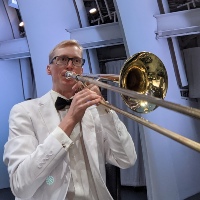
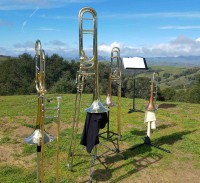
This week I've been playing one instrument a day. Today is alto trombone! I'm borrowing a Weril TIS, not a bad instrument... far beyond my playing ability to discern, for sure.
I was working out of the Sluchin alto method book and melting my brain a bit when I realized that:
When alto reads alto clef, the positions correlate with F contrabass reading in bass clef.
I'm not sure how many people have come across this. It's not a huge shortcut, I still need to really nail down exactly what note name I'm playing, but literally reading the music on the page just got a lot easier.
I never thought of this, but yes, you're right. I play F tuba and looking at my fingerings it does work out. Not sure how many people are going to play alto trombone coming from F contra, though.
Bruce Guttman
Merrimack Valley Philharmonic Orchestra
"Almost Professional"
Yup... also, the F tuba transcription of the Bach Cello Suites that Ralph Sauer did means you can use the same handslide positions on your contra that you do on your Bb tenor/bass (just sounding a fourth lower)- great for gaining contra facility.
Burgerbob wrote: Thu Jul 23, 2020 6:55 pm
This week I've been playing one instrument a day. Today is alto trombone! I'm borrowing a Weril TIS, not a bad instrument... far beyond my playing ability to discern, for sure.
I was working out of the Sluchin alto method book and melting my brain a bit when I realized that:
When alto reads alto clef, the positions correlate with F contrabass reading in bass clef.
I'm not sure how many people have come across this. It's not a huge shortcut, I still need to really nail down exactly what note name I'm playing, but literally reading the music on the page just got a lot easier.
I also came across this in college when I played a bass sackbut in F for the first and only time. It was one of those "hey this is weird" moments.
I mentioned it to a couple of pals at the time who just looked at me strange!
I never thought of that, but I think it would work for those who have played F-Contra. Cool trick!
I have noticed that many people who play alto are not comfortable with anything other than alto clef. Many of my buddies who play alto get very nervous when given a part that is written in tenor or bass clef. Since I am fluent in any clef or transposed part (horn in F, E-flat, D, all sax parts, flute, clarinet, etc...) on my tenor, I wanted to become as diverse in my reading skills on the alto.
I have used the pandemic as a time to get fluent with my alto in many different clefs and transpositions. It has made practicing alto very interesting. Some days I read all Horn in F music, other days bass clef up an octave, etc... I even have Trumpet Books with hundreds of marches in them to build my high chops. Playing those marches while reading the music as "Trumpet in C" is especially challenging. It's similar to some of the Bach Cantata parts written in Treble Clef, but the tessitura is just a little higher.
I have been in many situations where I was given a clarinet, horn or saxophone part to play on my tenor. I'm hoping that when this pandemic is behind us, I will be gigging someplace on alto and asked to play something bizarre like a D-flat piccolo part (that's one I have not tried) so that all this practice on alto can be put to the test!
Brian D. Hinkley - Player, Teacher, Technician and Trombone Enthusiast
Another quirky Alto Trombone Clef reading memory......
Doing Beethoven 9 many years ago and there was no 2nd trumpet for one reh. IIRC most of the part was for Trumpet in D which looks the same as.... Alto Clef! So I could shovel in the 2nd Trp part when the Alto Tbn wasn't playing.
Slidemo wrote: Tue Oct 13, 2020 3:30 am
Another quirky Alto Trombone Clef reading memory......
Doing Beethoven 9 many years ago and there was no 2nd trumpet for one reh. IIRC most of the part was for Trumpet in D which looks the same as.... Alto Clef! So I could shovel in the 2nd Trp part when the Alto Tbn wasn't playing.
Cool, I never thought about that transposition!
Brian D. Hinkley - Player, Teacher, Technician and Trombone Enthusiast